EN
EN
 jp
jp  ko
ko  es
es  ru
ru  pt
pt  th
th  ar
ar  vi
vi  id
id  kk
kk 
Construction
Build Better, Build Greener, with Celix HPMC

For dry-mix mortar producers, building contractors, and wall putty manufacturers, few quality failures are as costly or damaging to brand reputation as wall putty peeling, flaking, or chalking.
When a freshly rendered wall begins to blister, crack, or strip away under light abrasion, applicator crews typically point fingers at poor paint quality or damp substrate conditions. However, in white-cement, gypsum, or lime-based wall putties, the root cause of peeling almost always traces back to rapid moisture loss, incomplete binder hydration, or improper formulation chemistry.
In this technical breakdown, we analyze the 5 hidden causes behind wall putty peeling and demonstrate how choosing the correct grade of hydroxypropyl methylcellulose (HPMC) serves as the definitive cure for failure-free wall putty formulations.
White cement and hydrated lime are the primary inorganic binders in cementitious wall putties and skim coats. Unlike organic paints that dry purely through solvent evaporation, white cement requires sustained liquid water to fuel its exothermal chemical reaction—hydration.
Cement Binders+Water(H2O)→Calcium Silicate Hydrate(C-S-H)Gel+Mechanical Bond
If water is drawn out of the freshly applied putty layer too quickly, cement hydration stops prematurely. Without C-S-H gel crystal growth, the putty layer transforms into a soft, powder-like matrix with zero adhesive strength, leading directly to peeling and cracking.
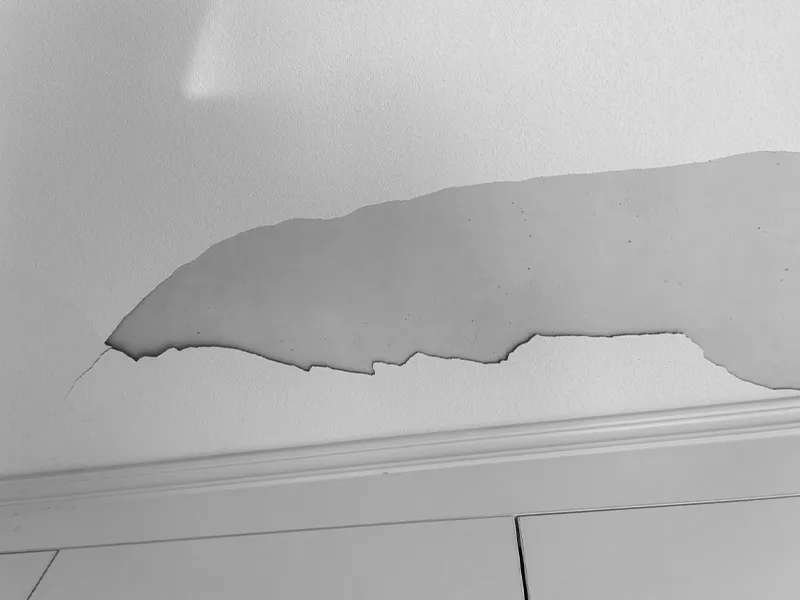
When applied over porous brickwork, concrete blocks, or Autoclaved Aerated Concrete (AAC), a dry substrate acts like a sponge, rapidly siphoning liquid water out of the paste. Concurrently, solar radiation and ambient wind accelerate evaporation from the outer surface. If the hpmc cellulose additive lacks sufficient water retention capacity(WR<98%), the putty layer starves of water within minutes, causing severe chalking and eventual peeling.
Without proper film-forming and moisture-holding additives, the liquid phase of the putty cannot penetrate deep enough into substrate capillaries to form an interlocking mechanical anchor. When the topcoat paint is subsequently applied, its drying tension pulls the weak, non-anchored putty layer right off the wall.
Inexpensive wall putties often rely on low-grade fillers with insufficient binder content. If the hydroxypropyl methyl cellulose additive does not build sufficient yield stress and high brookfield viscosity, aggregate particles separate from the cement paste during troweling. This segregation creates internal micro-voids and weak shear planes within the cured film.
Sourcing cheap, adulterated hpmc china products loaded with high salt or heavy ash content(Ash>10%)destabilizes cement hydration. Dissolved inorganic impurities alter cement crystal morphology, causing internal swelling, efflorescence, and interfacial debonding over time.
Attempting to make wall putty waterproof by over-dosing silicates or hydrophobic agents without adjusting the cellulose ether matrix can severely lower wet adhesion. The putty loses its wet tack during application, preventing proper leveling and causing the coat to roll up or strip away under the trowel.
Incorporating high-purity hydroxypropyl methylcellulose (HPMC) into dry-mix wall putty formulas addresses these failure points through three distinct chemical and physical mechanisms:
1.Ultra-High Water Retention(≥98%): Non-ionic hpmc polymer chains feature hydrophilic hydroxyl(-OH)and hydroxypropyl(-OCH2CH(OH)CH3)substituent groups that bind water molecules tightly via hydrogen bonding. This retains moisture within the layer even under 40℃ weather, ensuring 100% cement hydration and high surface hardness.
2.Optimized Rheology & Thixotropy: High-viscosity hpmc hydroxypropyl methylcellulose endows wet mortar with pseudoplastic flow behavior. The paste thins under trowel pressure for effortless application, then immediately rebuilds static viscosity to hold fillers in stable suspension without sagging or bleeding.
3.Enhanced Interfacial Adhesion: As the putty cures, dissolved hpmc polymer migrates slightly toward the substrate interface, forming a flexible continuous film that bridges microscopic voids between cement hydrates and aggregate particles.
To eliminate peeling while keeping raw material costs under control, dry-mix formulators must select the right hydroxypropyl methylcellulose specifications based on their target application:
1.Interior White Cement / Gypsum Wall Putty:
Recommended Viscosity: 100,000 – 150,000 mPa.s
Target Dosage: 0.15% – 0.25% (1.5 kg – 2.5 kg per ton)
Key Requirement: High water retention (≥ 98%), non-yellowing, low ash.
2.Exterior Cementitious Skim Coat / Anti-Crack Putty:
Recommended Viscosity: 150,000 – 200,000 mPa.s
Target Dosage: 0.25% – 0.35% (2.5 kg – 3.5 kg per ton)
Key Requirement: Superior weatherability, sag control, high slip resistance.
3.Modified Rheology Grade (Co-Formulated with Starch Ether):
Recommended Viscosity: 40,000 – 70,000 mPa.s + 0.05% HPS
Key Requirement: Maximum trowel smoothness, reduced hand fatigue, lower cost.
If your factory is experiencing quality issues with wall putty peeling or powdering, follow this step-by-step laboratory verification protocol:
1.Check Water Retention: Test your finished dry-mix putty according to EN 18555 or DIN 18555. If water retention drops below 98%, increase the HPMC dosage or upgrade to a higher substitution grade.
2.Verify Ash Content: Burn a sample of your raw hpmc cellulose in a muffle furnace at 575℃. Pure, unadulterated cellulose ether should yield an ash content below 3.0%-5.0%. High ash indicates heavy salt blending, which damages bond strength.
3.Assess Substrate Priming: On highly porous substrates (such as AAC blocks), instruct application crews to pre-wet the surface or apply a penetrating primer prior to troweling.
4.Combine with VAE RDP for Exterior Systems: For high-performance exterior wall putties, pair Celix HPMC with 0.5%-1.5% Redispersible Polymer Powder (VAE RDP)to boost flexural tensile strength and weather-resistance.
Align your quality control and laboratory testing with these recognized international standards:
1. EN 18555 / DIN 18555 Mortar Testing Standards: Consult DIN Standards Protocols for evaluating water retention value and consistency of fresh renders and mortars.
2. ISO 13007 Adhesion Testing Framework: Review ISO 13007 Specifications for tensile bond strength and open time testing procedures.
3. ASTM C1583 Direct Tension Adhesion: Check ASTM Tensile Testing Guidelines for measuring surface pull-off strength of wall coatings.
4. EU REACH Chemical Safety Directives: Review ECHA REACH Regulations regarding high-purity cellulose additive compliance.
Preventing wall putty failures requires more than just adding thickeners—it requires consistent chemical purity, precise substitution ratios, and expert formulation support
As a leading international cellulose ether factory and reliable HPMC manufacturer in China, Hebei Celix Cellulose Co., Ltd. (Celix) produces high-purity HPMC, HEMC, HEC, and redispersible polymer powders (VAE RDP) specifically optimized for white cement putties, skim coats, tile adhesives, and waterborne coatings. Featuring low ash content, superior thermal stability, and guaranteed water retention(≥98%), Celix products empower mortar manufacturers worldwide to deliver zero-defect wall finishes.
Build Better, Build Greener, with Celix HPMC
Clean Safer, Care Smarter, with Celix Cellulose Ether

Drill Deeper, Operate Safer, with Celix Cellulose Ether

Formulate Precisely, Deliver Safely, with Celix Cellulose Ether

Taste Better, Keep Fresher, with Celix Cellulose Ether

Shape Stronger, Fire Smarter, with Celix Cellulose Ether
Contact Us

Celix Cellulose Co., Ltd, is an integrated chemical cellulose manufacturer with in-house R&D, factories, and global sales sites.
Our products include HPMC, HEC, MHEC, VAE RDP, PCE, PVA, Defoamers, PP fibers, HPS, SHP and Gypsum Retarder.


Celix Cellulose Co., Ltd, is an integrated chemical cellulose manufacturer with in-house R&D, factories, and global sales sites.
Our products include HPMC, HEC, MHEC, VAE RDP, PCE, PVA, Defoamers, PP fibers, HPS, SHP and Gypsum Retarder.
Quick Links
+8618330106777
info@celixcellulose.com